
Leadership and Innovation
Degrees

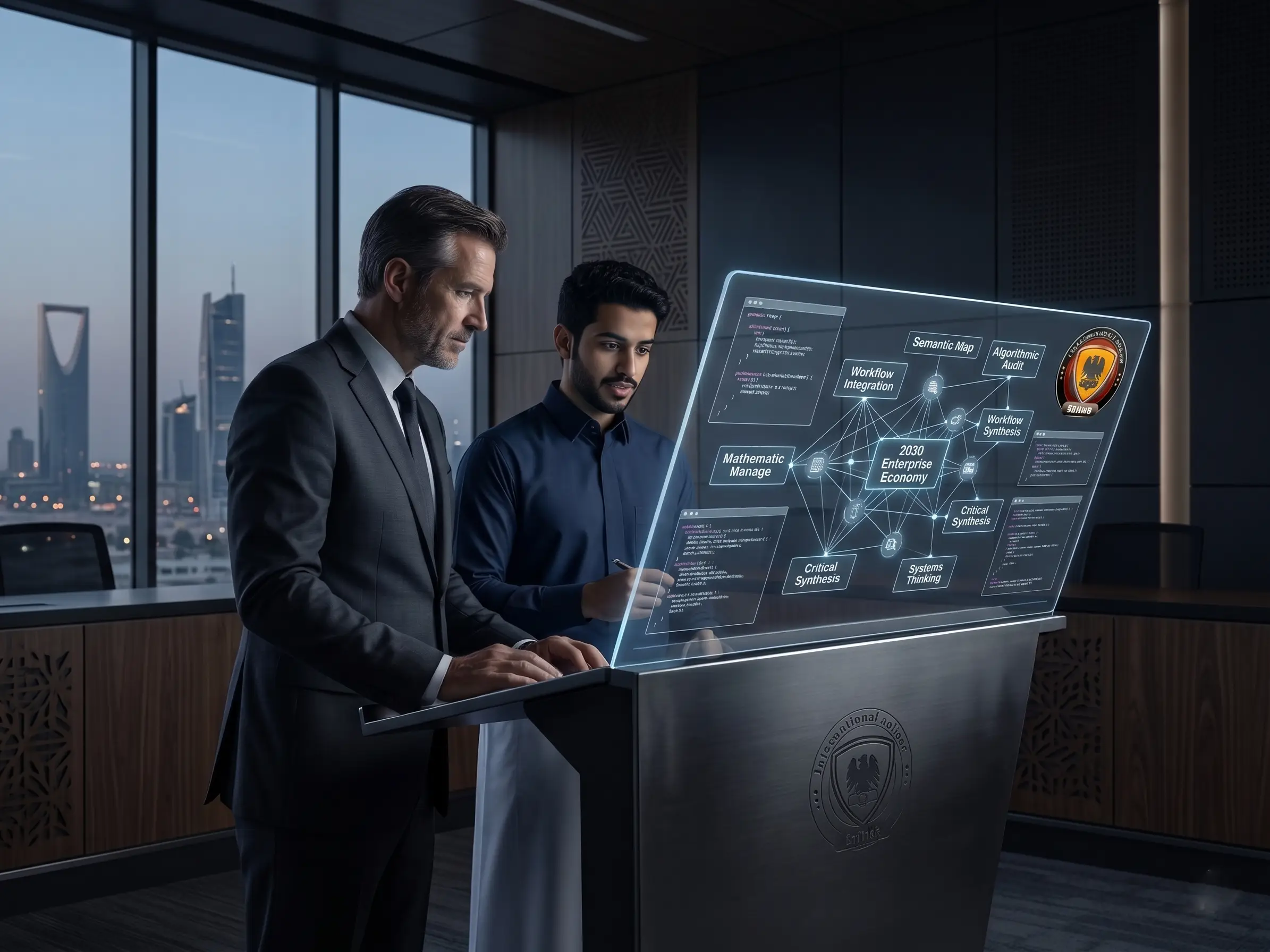
The deployment of AI in higher education MENA fundamentally transitions academic institutions from knowledge-delivery centers into algorithmic training hubs. To deliver truly future-proof degrees, a modern tech-integrated international college must replace rote memorization with advanced generative AI literacy and systems thinking. This structural realignment ensures graduates possess the analytical adaptability required to dominate the 2030 regional enterprise economy.
The economic mandates of the Middle East, driven by structural transformations like Saudi Vision 2030 and the Dubai Economic Agenda D33, demand a radically new caliber of graduate. The corporate sector no longer rewards basic information retrieval; generative search engines and enterprise AI models handle those tasks autonomously. Today, corporate value is generated entirely through critical synthesis, algorithmic oversight, and strategic execution.
For academic institutions operating within this high-velocity environment, integrating artificial intelligence is not an optional technology upgrade. It is a mandatory structural evolution. Aligning a college brand with tech-savvy expectations establishes vital topical authority in generative AI education trends, signaling to the market that the institution is actively engineering the next generation of global leadership.
Historically, higher education assessed student capability based on data retention. The integration of AI in higher education MENA shatters this legacy framework. When students possess instant access to comprehensive Large Language Models (LLMs), testing memory becomes irrelevant. Modern academic rigor is now defined by the ability to ask precision-engineered questions, validate machine-generated outputs, and integrate AI capabilities into complex operational workflows.
A curriculum built for the 2030 economy treats artificial intelligence as a collaborative entity rather than an outsourcing mechanism. Students must learn the underlying architecture of these models—understanding context windows, vector logic, and the ethical parameters of algorithmic decision-making.
Prompt Architecture: Training students to construct highly specific, multi-variable queries to extract accurate and usable corporate data from generative models.
Algorithmic Auditing: Developing the critical capacity to identify AI hallucination, bias, and logic gaps within automated research.
Workflow Integration: Teaching the technical synchronization of AI outputs with standard industry software, financial models, and project management ecosystems.
A degree's value is directly proportional to its market relevance upon graduation. Offering future-proof degrees means abandoning static syllabi in favor of dynamic, tech-aligned learning matrices. Top-tier international colleges are recalibrating their programs to ensure that every academic discipline—from business administration to engineering law—is filtered through an AI-centric lens.
This strategic alignment ensures that graduates do not enter the workforce competing against automation, but rather arrive fully equipped to direct and manage it.
|
Academic Metric |
Traditional University Model |
Tech-Integrated International College |
|
Primary Assessment |
Closed-book examinations focused on data recall. |
Open-AI, project-based audits requiring complex data synthesis. |
|
Research Methodology |
Manual indexing and siloed literature reviews. |
AI-assisted pattern recognition and advanced semantic mapping. |
|
Skill Longevity |
High risk of obsolescence within 3-5 years. |
Adaptive cognitive frameworks resilient to technological disruption. |
|
Enterprise Value |
Requires extensive corporate retraining upon hiring. |
Plug-and-play readiness for AI-driven corporate environments. |
Transitioning a traditional campus into a tech-integrated international college requires profound infrastructural changes. The lecture hall of the future operates as a hybrid environment where human intellectual capital is exponentially amplified by machine processing power.
By establishing this environment, forward-looking institutions build unassailable digital authority, demonstrating to ambitious students and enterprise recruiters that their educational pathways are systematically anchored in the future.
Intelligent Learning Management Systems (LMS): Utilizing predictive analytics to tailor individual student learning paths in real-time, identifying knowledge gaps before they impact performance.
Simulated Enterprise Environments: Deploying AI-driven business and engineering simulations that force students to resolve high-stakes, multi-variable crises under realistic corporate constraints.
Data-Driven Faculty Governance: Equipping professors with advanced pedagogical data metrics to continuously optimize course delivery and maintain strict alignment with global industry standards.
The 2030 corporate landscape will not accommodate obsolete skill sets. Align your academic trajectory with the forefront of technological innovation and command the AI-driven enterprise sector.
[Apply Now for the 2026 Intake — Step Into the Tech-Integrated Classroom and Future-Proof Your Career Today
It is considered one of the largest universities, as it has more than 65 accredited training programs. The student in the program obtains internationally accredited certificates and is certified by the study embassy What distinguishes our university from other universities in Britain is the large number of accreditations it enjoys, which makes it at the forefront of international universities that organize professional programs. It is a member of the UK Register of Centers for Education Providers (UKRLP) Search with registration number 10065749. It is also a member of the list of accredited non-governmental organizations of the Economic and Social Council of the United Nations, and also a registered member of the European Union's Transparency Register under the number TR-Q-2017-22003.

internationalcollege-online

